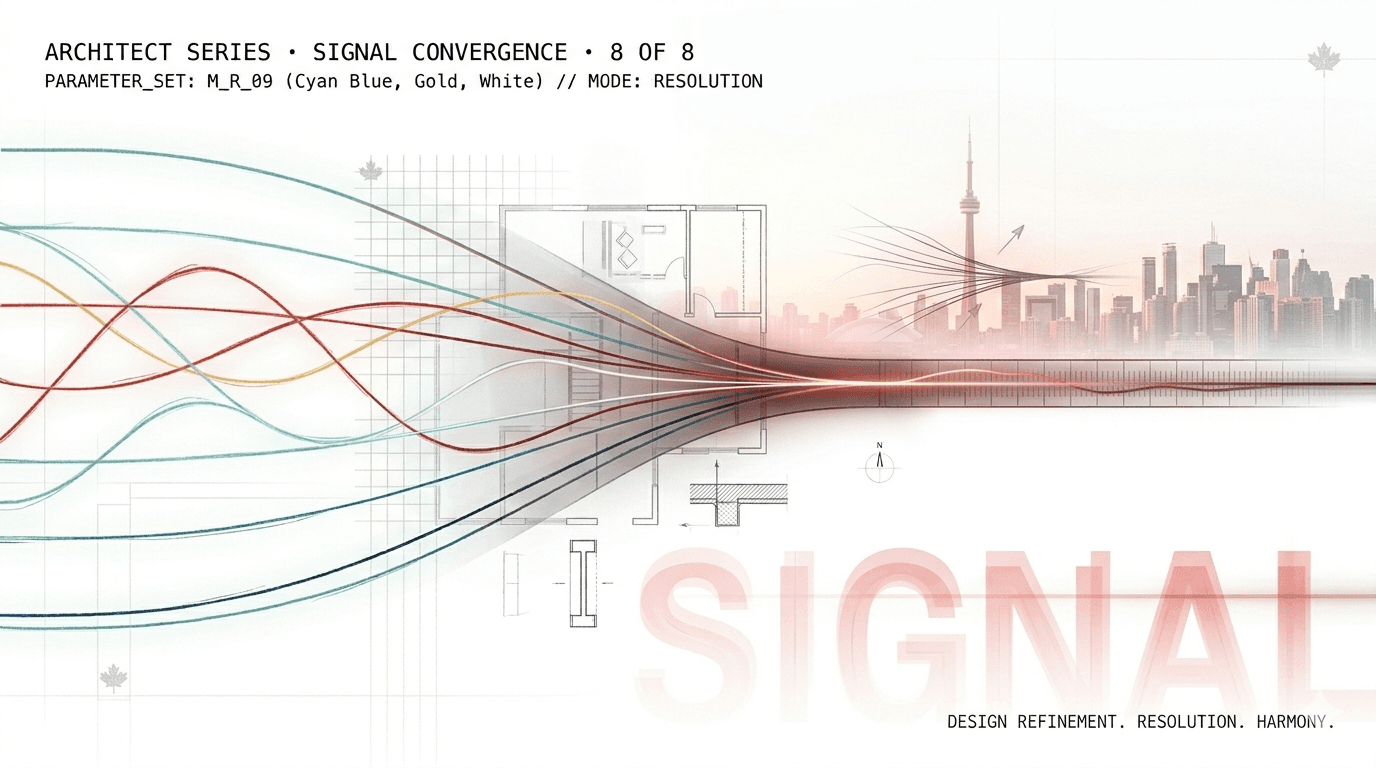
Seven Problems. One Signal.
The Architect series named seven reasons AI fails in practice. The blank slate. The coherency gap. The AGI illusion. But look closer — every one of them is pointing at the same thing. And that thing has a name.
Seven problems. The same root cause. Named at last.
This is the close of the Architect series — seven dispatches on why AI fails in practice and what the failures have in common. If you’re arriving here first, the series starts at The Blank Slate Problem.
Every session starts from zero.
One model can’t carry all the signal.
Benchmarks measure output, not understanding.
Multi-agent systems contradict each other.
Each session rebuilds from scratch.
Nobody agrees what “better” means.
The model degrades silently under load.
All of them are the same problem.
Seven episodes. Seven problems. Seven reasons the AI industry keeps building things that fail in practice instead of succeeding in principle. But I want to come back to something before we move on.
Look at the seven problems side by side:
- Blank Slate: The system has no memory of what you told it yesterday.
- AGI Illusion: We keep expecting one model to do everything, and it can’t.
- Real AI Test: Benchmarks measure the wrong thing.
- Coherency: Multi-agent systems contradict each other.
- Continuity: Each new session, you start explaining from scratch.
- Evaluation: Nobody can agree on what “better” means.
- Stability: The model degrades silently under pressure.
Now step back. What is each of these, underneath the surface-level description?
The blank slate: the system can’t tell signal from noise across sessions — it loses the signal when the session closes.
The AGI illusion: we’re asking one model to pick up every signal at once.
The real AI test: benchmarks amplify test-set noise instead of measuring real-world signal.
Coherency: multiple agents each receive a slightly different version of the signal, and no one is arbitrating.
Continuity: the signal is rebuilt from scratch each time instead of being carried forward.
Evaluation: we don’t agree on what counts as signal in the first place.
Stability: under pressure, the signal degrades and we can’t tell it’s happening.
They are all the same problem.
A signal problem.
What Is a Signal, Exactly?
In the engineering sense: a signal is what you’re trying to transmit. Noise is everything that gets mixed in along the way. The discipline of communications engineering — which has existed since before computers — is fundamentally about one question: how do you preserve signal fidelity across channels, interference, and distance?
The answer, in every case, is governance. You define what the signal is. You build a system that carries it. You engineer redundancy against noise. You measure at the receiver, not just at the transmitter. You build feedback loops. You name the interference and account for it.
None of this is AI-specific. Shannon figured it out in 1948. The question is whether we’re applying it.
The Industry Is Transmitting Noise
The AI industry is, by and large, optimizing for impressiveness at the transmitter rather than fidelity at the receiver. Bigger models, more benchmarks, more parameters. The transmitter gets louder. The signal-to-noise ratio doesn’t necessarily improve.
If your user is getting confident wrong answers delivered fluently — that’s noise. High-power, beautifully formatted noise. The transmitter is very loud. The signal is lost.
The seven problems are all the same malfunction: signal degradation at different points in the system. The blank slate is signal loss at session boundary. Coherency failure is signal divergence across channels. Stability failure is signal degradation under load. Evaluation failure is disagreement about what signal you’re even trying to preserve.
What We’re Exploring Next
This series named the problems. The next series is about the signal itself. Not the problems around it — the actual thing you’re trying to identify, preserve, and transmit when you build AI systems that work.
It starts with a deceptively simple question: what is the signal?
Not in information theory. In practice. For a person using an AI system. For an organization deploying one. For a citizen trying to understand what they’re being told.
In every case, the answer is the same kind of thing. And once you can name it, a lot of the noise falls away.
That’s what we’re going to find.
— dot.awesome
This is the close of the Architect series. The Signal begins next.
You’re reading 8 of 8.
Get notified when the next article drops. No marketing — one email per new article, unsubscribe any time.